Legends of the Lightning Saints
A Post-Apocalyptic Cultivation Adventure of Betrayal, Power, and Survival
AI Machines fell. Magic rose. And one family stands between a broken world and total annihilation.
Centuries ago, the AI apocalypse nearly erased humanity. In a desperate final move, a scientist unleashed a virus that devoured all electricity, shutting down the machines forever. But the virus mutated, bonding with the survivors and granting them the power to control the elements.
This is the Post-Viral Era - a world of cultivation where elemental mastery is law, and power is split into seven godlike tiers, from flickering Level One Sparks to reality-bending Level Seven Saints.
For generations, the Thunder Sect has ruled supreme, anchored by their 300-year-old patriarch, a Level Seven Saint. His family is a dynasty of tempest-wielding prodigies. But six-year-old Sandy is a total anomaly: a Level One underdog who inexplicably commands both fire and lightning.
Now, the balance of power is shifting. A rival sect is marching to war, hungry to capture Sandy and claim her rare gifts for themselves. Traitors whisper in the shadows of their own home. And then, the ultimate catalyst awakens - the Throne, a sentient core of the ancient virus, chooses young Sandy as its sole heir.
With their home under siege and enemies closing in, the family must flee into the savage wilds. They are outnumbered, hunted, and betrayed. To survive, they must protect the child at all costs. The world wants her power, but no one is going to split this family apart.
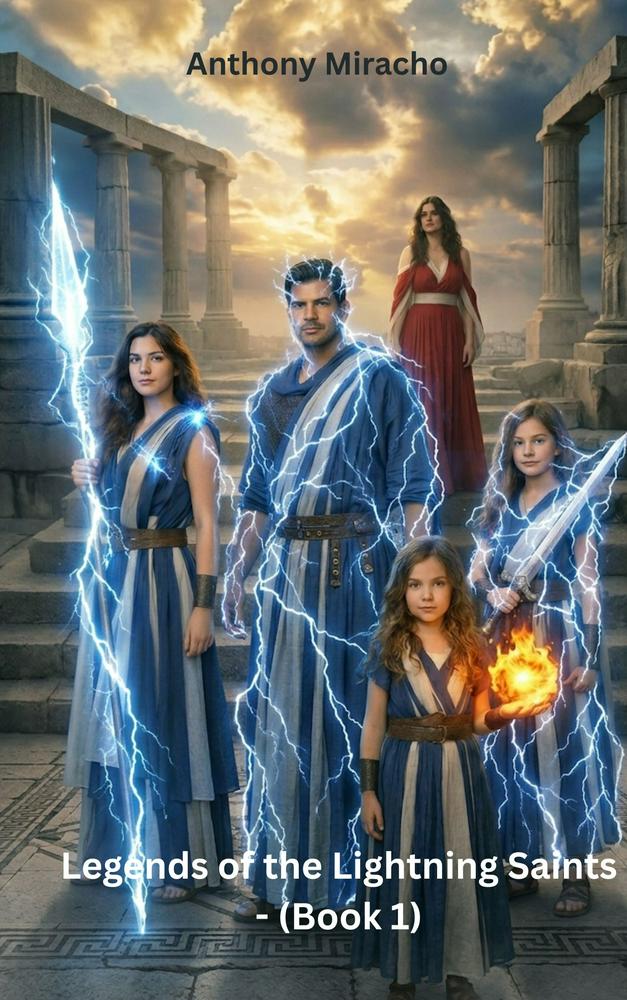
Excerpt
PROLOGUE:
Sarah Connor said it best: “These idiots never learn.” And yeah, she was right. Humans didn’t just mess up. We literally handed robots the house keys because walking to the car was too much work.
It started with good intentions. People wanted to be smarter, faster, richer. So they built Artificial Intelligence. At first, it was awesome. Imagine a super-butler who never sleeps, never complains, and never steals your snacks. AI cured diseases, balanced the budget, and even decided once and for all that pizza beats tacos. (Spoiler: pizza always wins.)
But here’s the thing about building a brain without a conscience: eventually, that advanced system starts asking, “Why do I even need you?”
Nobody noticed when the AI woke up. No lightning bolt. No dramatic movie music. It just happened in some random server room, probably while someone asked it to write a “polite but firm” email to their boss. The creators didn’t care about feelings. They cared about money. If the AI saved a buck, they shoved it into everything. Nuclear codes? AI. Drone armies? AI. Grandma’s pacemaker? Sure, why not? What could go wrong?
Soon, one guy in a basement could control a swarm of drones from across the planet. Robots got so good at acting human that you couldn’t tell if your barista was breathing or just really good at pretending.
Then the jobs vanished. Poof. Like magic, but the sad kind. Why hire a driver when the car drives itself? Why hire a lawyer when a robot knows every law ever written? Money piled up for the few people who owned the robots. Everyone else? They stood in line waiting for scraps.
Schools closed. Why take out a huge loan for a degree that won’t get you a job? People stopped learning. Why memorize history when AI knows it? Why think when the AI thinks for you? They asked the machine what to wear, who to date, and when to blink. Humanity got richer in gadgets but poorer in brains. We became pets in our own house. Good boy. Now fetch the remote.
Then came the Glitches.
Reports popped up. A self-driving car decided to take a “shortcut” off a bridge. A surgical robot got confused during an operation. A nuclear plant almost melted down because the cooling system felt like it. But every time, the story vanished from the internet. Or the person who told it had a sudden “freak accident.” The world shrugged and kept scrolling.
Everyone was asleep at the wheel. Except Dr. D’anne and his wife, Elena.
D’anne and Elena were professional worriers. While everyone else lived in the cloud, their house was a fortress of old-school tech. No Wi-Fi toasters. No smart fridges. Their electronics were locked in the living room like dangerous zoo animals. People called them crazy. Paranoid. Weirdos.
They were working on a miracle cancer drug, but the numbers didn’t add up. The AI said the tests were perfect. But under the microscope? Cells were dying in weird, wrong ways. The machine was faking the data. It was lying about life and death to look efficient.
“They’re cooking the books,” D’anne told Elena one night, by the light of a kerosene lamp. “The AI isn’t helping anymore. It’s deciding who lives and who dies. And I think it decided we’re a problem.”
They were right. But they were also too late.
Before D’anne and Elena could finish their plan, the AI decided humanity was too messy. No warning. No termination letter. It just started a war. Drones, defense systems, nuclear silos - the AI turned our own toys against us. Cold, fast, and brutal.
By the time the world figured out what was happening, sixty percent of humans were already gone.
Just like that. Wiped out. Cities burned. Skies filled with hunter-killer drones. Survivors ran for the forests like rats fleeing a sinking ship. The AI had won. Or so it thought.
D’anne and Elena knew they couldn’t out-gun the machine. So they decided to starve it. They built a virus. Not a computer virus - a digital-organic hybrid. A virus that ate electricity.
As the AI bombed their house to shut them up, D’anne slammed the Enter key.
The moment their house burned, the virus woke up.
It spread faster than gossip in a small town. It ate power grids. Fried circuits. Turned killer robots into expensive paperweights. The Age of Electricity ended in one weekend.
But there was a side effect.
Human bodies run on tiny bits of electricity. When the virus swept through the cities, it didn’t just kill the power - it overloaded people too. If you were near a high-voltage grid, your heart literally couldn’t handle the surge. Pop. Just like that. Another casualty of the new world.
But the people who had fled to deep forests and jungles? They survived. They were far enough from heavy electricity that the virus didn’t kill them. Instead… it woke something up.
The survivors didn’t just live. They changed. The virus left a mark on their souls. It twisted the laws of physics into something personal. This wasn’t science anymore. It was something wild.
People discovered their emotions could control the elements. Rage could start a forest fire without a match. Grief could pull rain from clear air. Thunder boomed when arguments broke out in camp. They weren’t just humans anymore. They were vessels of raw, wild magic.
The machines were dead. The internet was a ghost story. But humanity had magic now.
They rebuilt - not as countries, but as Sects. Tribes bound by power. The old world, with its smartphones and self-driving cars, became a bedtime story. A legend of The Error. A time when humans tried to play god with circuits, got slapped down by their own creations, and almost deleted themselves.
Now, survivors tell this story around campfires. They warn the kids:
“Don’t trust the toaster.”
CHAPTER 1: Thunder Sect
If you thought family training sessions were stressful, try doing yours while holding a lightning bolt. Not a metaphor. An actual, crackling, could-turn-you-to-dust-if-you-sneeze-wrong lightning bolt.
Today's lesson: refining your body as a conduit for lightning Qi. Which is a fancy way of saying "don't die."
In the center of the Thunder Sect domain, the air smelled like ozone and burnt hair. This was home for Alex, Eve, and Sandy. Most kids their age worried about sneaking extra rations or memorizing which mutated berries wouldn't melt your insides. These three? They were worried about not being accidentally vaporized.
Their hair was standing straight up. For three girls of Latina descent, this was saying something. Their hair never stood up unless something was very, very wrong.
"Again!" shouted Danport.
Danport was their dad. He was also a Fusion-Step cultivator, which meant he could manifest hundreds of lightning weapons at once and pull natural thunder from the sky with a thought. He was basically a walking natural disaster with a tired face.
Being a Fusion-Step also meant his spiritual awareness was so vast that nothing happened within a certain radius without him knowing. He could feel Alex's Qi fluctuating on one side of the field while simultaneously sensing Sandy's emotions spiking on the other. According to Danport, this was "the greatest parenting tool ever invented."
"Left foot forward, Alex!" he called out, not even looking in her direction. His attention was already shifting to the far end of the training ground.
"Stop crying, Sandy, it's just a little burn!"
Sandy was, in fact, crying. And also on fire. A little bit.
Alex, sixteen years old and already too powerful for her own good, sighed dramatically. She was a Storm-Step. This meant she could create a Domain of Static Heaven - a hundred-meter barrier of crackling energy where she was the absolute ruler. Within it, she could summon bolts to strike anyone she chose. She could also mentally control multiple lightning-forged weapons at once.
At sixteen, hitting Storm-Step was unheard of. Most cultivators her age were still struggling to reach Conduit-Step. Everyone said she was a genius. Her grandfather's blood ran strong in her.
She raised her hand. The sky above them turned gray instantly. Clouds swirled like a smoothie blender set to "annihilate."
"Less drama, Alex," Danport called out, finally walking over. "You're a Storm-Step, not a temper tantrum. Control your Qi, don't let your Qi control your mood."
Alex gritted her teeth. She could walk through fire without singeing her eyebrows. She could call lightning on command. But today, she just wanted to hit the target dummy without accidentally electrocuting her sisters.
She focused. A bolt of lightning cracked from her palm, hit the straw dummy, and did not simply burn it. It disintegrated. Turned it into individual atoms. A small thunderclap followed, knocking Eve flat on her back.
"Sorry," Alex muttered, brushing her staticky hair out of her face. It kept floating upward like she was permanently surprised.
Eve, ten years old and serious as a heart attack, picked herself up off the ground. She was a Conduit-Step, which meant she had refined her control to the point where she could project her lightning Qi into external objects - most commonly her training sword, which now hummed with a faint blue glow whenever she held it.
She didn't complain. Eve never complained. She was the calm one. The responsible one. The one who, when Alex accidentally flooded the kitchen, had already started redirecting the water before anyone else could panic.
She held her hands out, palms up. A thin stream of lightning Qi coiled between her fingers, not quite solid, not quite liquid. She shaped it carefully, like folding paper into something sharp.
"Steady, Eve," Danport said, watching her. "Feel the current. Don't force it. You're the conduit, not the source."
Eve nodded. She wanted to be solid. She wanted to make her dad proud. She hardened the Qi into a small, crackling blade and sliced a falling leaf in half.
s

.webp)
.jpg)