The Last Druid
An Enemies to Lovers Dystopian Romantic Fantasy
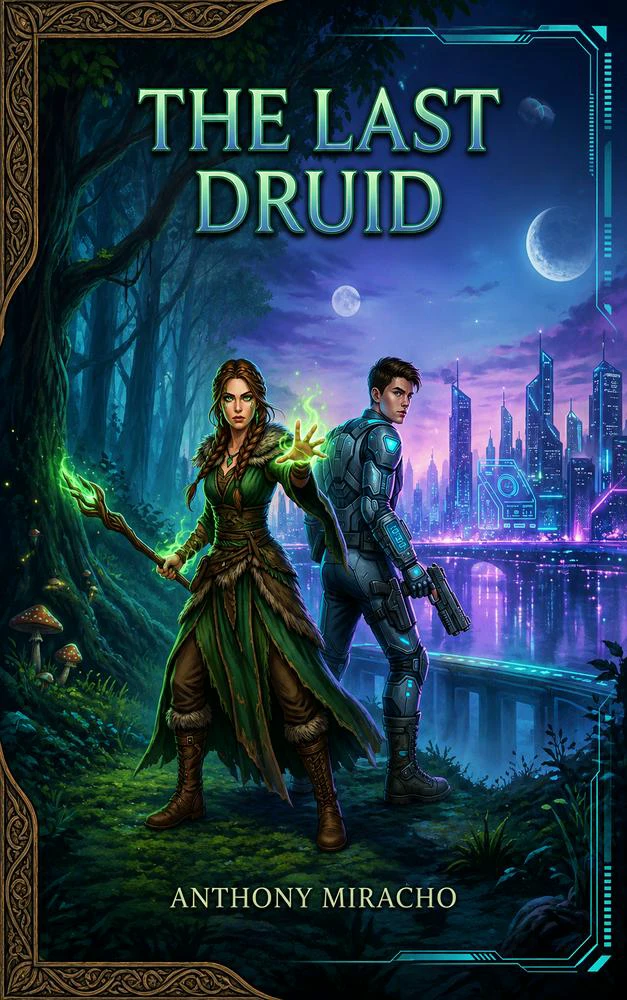
She was born to heal a dying earth. He was engineered to hunt her down.
In a grey, ash-choked world ruled by a ruthless Empire,
Elara Drake hides a deadly secret.
She isn’t just another worker at the Sector 47 filtration plant - she can hear the agony of the dying world spirit, Isla. Forbidden earth magic pulses through her veins, a capital crime in a society that blames ancient Druids for the apocalypse.
When an imperial drill triggers an ecological crisis, Elara’s magic erupts in a burst of impossible greenery, exposing her to the very monsters she fears.
Commander Kaylen is the Empire’s most lethal weapon. Fused with cybernetic gauntlets and sworn to eradicate the Druid resistance, he tracks the mysterious green-eyed girl into the perilous Dead Zone. He expects a terrorist. He finds a survivor who defies everything he’s been taught to believe.
An forced alliance. A toxic wasteland. A love that could shatter an empire.
When their transport ship crashes deep in enemy territory, the hunter and the hunted must rely on each other to survive. As the harsh wilderness forces them together, Kaylen's icy armor begins to crack, and Elara uncovers the heartbreaking truth behind the Empire's creation. With the heart of the world caged beneath the Capital, they must navigate fake betrayals, brutal stakes, and a bond that defies destiny.
If you love high-stakes dystopian worlds, sizzling enemies-to-lovers tension, and powerful elemental magic, you’ll devour the first book in this addictive romantic fantasy series.
Excerpt
Prologue
Randrick stood at the window, looking out at the Empire that was slowly beginning to grow leaves.
It was a strange sight. For so long, the Capital had been nothing but grey - grey buildings, grey streets, grey skies. But now, tiny green shoots were pushing up through the cracks in the concrete. Flowers were blooming in the gardens. Trees were beginning to stretch their branches toward the sky.
It was beautiful. It was hopeful. And it was the most dangerous thing Randrick had ever seen.
He watched the people below, their faces turned up toward the sky. They were beginning to question his authority, and he couldn't have that.
Ingrates, he thought, his jaw tightening with anger. They don't appreciate what I've given them. They don't understand what it took to build this world.
He turned away from the window, his mind churning with dark thoughts. The people thought he was a pushover. They thought they could take advantage of his mercy, his patience.
He needed a measure to ensure that he was always in control. Always the one in power. Always the one they feared.
Fear. That was the key. If they feared him, they would obey him. If they were too exhausted to think, they would never question him. It was simple. It was brutal. And it was the only way to maintain order.
He sat down at his desk, pulling out a piece of parchment and a pen. He began to write, his hand moving with cold precision.
The first part of his plan was simple. He would form a squad of ruthless individuals - men and women who had nothing to lose and everything to gain. They would be his shadow squad, his enforcers, his instruments of terror. They would commit orchestrated acts of violence - killings, beatings, destruction - acting as terrorists so the empire's protectors would come to people's aid gaining their loyalty.
The second part of his plan was more insidious. He would introduce a synthetic sun, a massive orb that would hang in the sky and provide endless light. It would be beautiful, yes. But it would also allow him to force the people to work fourteen hours a day. They would be so exhausted, so beaten down, that they would never have time to think. They would never have time to question. They would never have time to rebel.
The hunters would follow orders with absolute loyalty. This could only be garnered by those who thought they owed him their lives. He would find the broken, the desperate, the ones who had nothing left to lose. He would give them purpose. He would give them power. And in return, they would give him their unwavering devotion.
Chapter 1: The Girl Who Talked to Dirt
Elara
The ash fell like dirty snow, blanketing everything in a fine grey powder that got into your lungs, your hair, and your soul if you let it.
I wiped my forehead with the back of my hand, smearing grime across already-grimy skin. Another day in paradise. And by paradise, I meant the outer sectors of the Empire - where the air tasted like rust and hope went to die.
My shift at the filtration plant was finally over. Twelve hours of hauling contaminated sludge, breathing through a mask that did approximately nothing, and pretending I didn't notice the way my coworkers' eyes glazed over when they looked at the horizon. We'd all given up on the horizon. There was nothing out there but more grey.
"Hey, Root Girl!" Someone called from across the processing floor. I didn't even bother turning around. I knew that voice. That was Markus, my shift supervisor, a man whose personality was as pleasant as the toxic runoff we processed.
"It's Elara," I muttered under my breath, but I turned anyway. "What?"
Markus gestured vaguely toward a massive pile of what I could only describe as 'garbage that had given up on life.' "Need you to clear section D before you go. High Commander's inspection tomorrow. Everything needs to look..." he paused, searching for a word his limited vocabulary could grasp. "Not like this."
I looked at the mountain of refuse. I looked at my watch. I looked at the exit, which was approximately fifty feet away and represented freedom, food, and maybe a nap if I was lucky.
"Section D," I repeated flatly. "By myself."
"You got legs, don't you?" Markus grinned, revealing a mouthful of teeth that hadn't seen a dentist since the Before Times. "Get moving. And try not to break anything expensive. We can't afford to replace you."
'Can't afford to replace me', I thought as I trudged toward the garbage pile. What a joke. They could replace me with a moderately motivated rock and get about the same productivity.
The filtration plant sat on the edge of Sector 47, one of the outer rings of the Empire's territory. Once, years ago, this had been a thriving agricultural region. My grandmother used to tell me stories about it, back when I was small enough to sit on her knee and believe in magic.
"Animals everywhere," she'd say, her eyes growing distant and dreamy. "Not just the livestock we kept for food, but wild ones too. Deer with antlers like tree branches. Rabbits that would pop out of holes in the ground. Birds - oh, the birds, Elara. They'd fill the sky like a living carpet, their songs so loud you couldn't hear yourself think."
I used to beg her for more details. What color were the birds? What did they sound like? What did it feel like to walk through a field that wasn't grey and dead?
"The grass would tickle your knees," she'd tell me. "And there were flowers everywhere. So many colors. Red and yellow and purple - like someone had spilled paint across the earth. And butterflies would dance between them, all orange and black and blue. I remember catching one once, when I was a girl. It sat on my finger for a whole minute before flying away."
I'd close my eyes and try to imagine it. A world that wasn't grey. A world that wasn't dead. A world where you could open your mouth and breathe without tasting ash and regret.
But those days were gone. Long gone.
Now it was a graveyard of dead soil and broken dreams. The Empire had sucked everything out of the land - minerals, water, life itself - to feed their gleaming Capital in the center of what used to be the continent.
My grandmother told me about the insects too. "You couldn't walk through the fields without getting covered in them," she'd say, laughing at the memory. "Bees buzzing from flower to flower. Grasshoppers jumping out of your way. Fireflies at night, lighting up the darkness like tiny stars."
I'd never seen a firefly. I'd never seen a bee. The only insects I knew were the ones that had adapted to the contamination - hard-shelled things with too many legs, the kind that made you want to scrub your skin raw if they so much as brushed against you.
"The animals were the best part," my grandmother would continue, and her voice would get soft and sad. "I remember the smell of fresh milk in the mornings. The sound of chickens clucking. And the horses - oh, how I loved the horses. They were so big and gentle. I'd brush their manes for hours, just talking to them."
I'd ask her what they talked about, and she'd smile that mysterious smile. "Everything," she'd say. "Horses are good listeners. Better than most people."
I'd never even seen a horse except in the old picture books my grandmother had hidden under her mattress. They looked like creatures from another world - muscular and proud, their manes flowing in the wind. I used to dream about them. About riding one across a green field, the wind in my hair, the sun on my face.
But those were just dreams. In the outer sectors, the only animals you saw were the ones the Empire bred for food or labor. Pale, sickly things that barely survived the contamination. Their eyes were always dull, always hopeless. Like they'd given up on life just like everyone else.
"Don't forget what they took from us," my grandmother would whisper, her hand gripping mine. "The world was beautiful once. It will be beautiful again. You have to believe that, Elara. You have to keep hoping."
I believed her, even when it felt foolish. Even when the ash filled my lungs and the grey skies stretched on forever.
I had to believe. Because if I stopped believing, I'd stop fighting. And if I stopped fighting, the world would truly be dead.
But there was something I never told my grandmother.
Something that had started happening to me around the time I turned twelve, when the green veins first appeared in my irises and I realized I wasn't like everyone else.
I could hear the earth.
Not with my ears - with something deeper. Something that lived in my bones and my blood and the spaces between my thoughts. It wasn't a voice exactly. It was more like a feeling, a hum, a vibration that traveled up through my feet and into my chest. It was the heartbeat of the world, and it was dying.
I didn't know what to call it at first. I thought I was going crazy. That the contamination had finally gotten to my brain, that I was losing my mind the way so many sector workers did. But the feeling didn't go away. It got stronger. And eventually, I learned to listen.
That's when I first heard her.
'Isla.'
The name came to me in a whisper, soft as wind through dead grass. Not a word, exactly - more like a feeling that carried meaning. The earth. The spirit of the living world. The consciousness that had been there since the beginning, before the Empire, before the burning, before humanity had forgotten how to listen.
She was calling to me. And she was in so much pain.
I learned to feel it when she hurt. It was like a cold dread settling in my stomach, a weight on my chest that made it hard to breathe. Sometimes it came suddenly, a sharp stab of agony so intense I'd double over, my hands clutching my stomach as I tried to figure out what was happening.
Those were the times when the Empire drilled deep she would whisper. When they ripped minerals from the earth, tore open its veins and drained them dry. Isla would scream, and I would feel every second of it. They were draining her essence.
And then there was the grief. The slow, constant grief of a world dying by inches. It was there all the time, a dull ache in the background of my existence, so familiar I'd almost stopped noticing it.
Almost.
But I noticed when it got worse. When the Empire expanded their operations, pushed deeper into the earth, took more than they already had. The grief would swell until it felt like drowning, like I was being pulled under by a sadness so vast I couldn't even comprehend it.
Isla was old. Older than the Empire, older than humanity, older than anything I could imagine. She'd been here for since the beginning, gave birth to continents, volcanoes ,forest etc, more over she had watched life evolve and change and flourish.
And now she was dying.
The Empire had been draining her for over a years, sucking out everything that made her what she was. They called it resource extraction. They called it progress. But I knew what it really was. It was murder, slow and methodical, and I was the only one who could hear her screams.
If this continued it would lead to extinction - like literal extinction - the earth would explode she had warned me. But I didn't know how to stop it.
Sometimes, late at night when the grid was quiet and I couldn't sleep, I'd lie in my bed and listen. I'd feel Isla's pulse beneath the concrete, so faint and weak I had to concentrate to find it.
'I'm here', I'd think, reaching out with my mind. 'I'm still here. I haven't forgotten you.'
And sometimes, so rarely I thought I might be imagining it, she'd answer. A warmth that spread up through the floor and into my chest. A feeling that wasn't quite a word but carried so much meaning.
'Child', she'd seem to say. 'My child. You came back.'
I never answered her directly. I was too scared. Too careful. The Empire had ways of finding people like me, and if they caught me, they'd kill me. They'd kill Isla too, if they could.
But I wanted to. So badly. I wanted to tell her I was still fighting, still hoping, still doing everything I could to keep a spark of life alive in this dead world.
And sometimes, when I couldn't help myself, I'd whisper back.
"I'm here," I'd say, so quiet even I could barely hear it. "I'm not going anywhere."
I reached Section D and stared at the task ahead. The pile was mostly empty chemical containers, broken machinery, and - I squinted - was that someone's entire apartment? Couch included? Great.
My hands found the metal of the first container. I began to drag it toward the processing chute, ignoring the way my muscles screamed in protest. I'd been doing this for five years now. Five years of manual labor, of eating nutrient paste that tasted like regret, of pretending I was just another faceless worker in the Empire's vast machine.
But I wasn't. I knew I wasn't. And that was the terrifying part.
I paused, letting go of the container for just a moment. I looked around. No one was watching. Markus had wandered off to terrorize someone else. The other workers on my shift were too exhausted to notice anything beyond their own misery.
I let my eyes drift closed. Just for a second.
Beneath my feet, I felt it. Isla. That faint whisper of something alive, buried deep under layers of concrete and dead earth. Her pulse was weak and distant, like a dying heartbeat.
'I'm here', I thought, reaching out with my senses. 'I'm still here.'
The earth didn't answer. It was too far gone, too drained. But I felt the memory of what it used to be. Forests. Rivers. Creatures that didn't have to wear filtration masks just to exist.
And I felt something else too. Isla's pain.
It came in a wave, so sudden and sharp that I gasped. The Empire was drilling again. Somewhere far away, deep in the earth, machines were tearing into Isla's flesh, ripping out everything she had left.
I could feel it. The agony of being torn open, of having your insides ripped out while you were still alive. It was overwhelming, dizzying, too much to bear.
"Elara! You okay?"
I opened my eyes to find one of the other workers staring at me. It was Mira, a woman about my age who'd been on the same shift for the past two years. She was one of the few people in this place who was actually kind to me.
"Yeah," I said, forcing a smile. "Just... tired. You know how it is."
Mira nodded, her expression sympathetic. "Get some rest after this. You look terrible."
"Thanks," I said dryly. "Always good to hear."
She laughed and moved on, and I was alone again with the garbage and the grief.
Isla's pain was still there, a dull ache in the background of my consciousness. I'd gotten good at compartmentalizing it over the years, at pushing it down to where I could almost ignore it. But it never really went away.
I imagined her as she must have been. Vibrant and alive. Covered in green, breathing with the rhythm of the seasons, her forests teeming with creatures that had never known the touch of metal.
And then I imagined what had happened to her. The strip mining that had torn her open, the pollution that had poisoned her blood, the concrete that had sealed her wounds and suffocated her lungs.
The grief, when it came, was so profound I couldn't even name it.
I grabbed another container and heaved it toward the chute. The metal screeched against the ground, drowning out any further thoughts of rebellion.
Rebellion was for people who could afford hope.
The walk back to my apartment took forty minutes. I could have taken the transit pod, but that would have cost credits I didn't have. So I walked, through the narrow alleys of Sector 47, past the endless rows of identical housing units, past the vendors selling questionable food from carts that had seen better years.
The air was thick with contamination. I could taste it on my tongue, a bitter metallic tang that never quite went away. The mask I wore helped a little, but not much.
My grandmother used to tell me about fresh air. "You could breathe it in and feel your lungs expand," she'd say. "It smelled like flowers and grass and rain. It smelled like life."
I couldn't even imagine that. The only smells I knew were ash and chemicals and the sour stench of desperation.
My apartment was on the fourteenth floor of a building that had been old when my grandmother was young. The elevator hadn't worked in years, so I climbed the stairs, my joints popping in protest with each step.
Inside, I locked the door, checked the windows, and collapsed onto my mattress. It wasn't much - a thin pad on the floor, a single blanket, a small table with a burner for heating water. But it was mine. And more importantly, it was private.
I reached under my mattress and pulled out my secret. It wasn't much. Just a small pot, no bigger than my fist, filled with soil I'd smuggled from the greenhouses in Sector 47. The greenhouses were one of the Empire's few concessions to the outer sectors - places where they grew actual food for the elite. But the soil there was contaminated, just like everything else. It needed help.
I placed the pot on my table and sat in front of it. My fingers drifted to the dirt, touching it gently.
"Hey," I whispered. "It's me again."
The soil was dry. Lifeless. Just dirt, the same as any other dirt in the sectors.
But I could feel it. The faintest spark of something buried deep inside. Something that remembered what it was to be alive.
I closed my eyes. I breathed. And I reached.
The world shifted. I could feel it - the tiniest thread of connection, like a spiderweb stretching from my fingertips into the soil. I followed it, down into the earth, past the contamination, past the dead zones, until I found what I was looking for.
Isla.
She was there, somewhere deep below. A flicker of warmth in the cold, dead ground. A pulse so faint I could barely feel it.
I could share my power with her to alleviate her pain. Though little it help her.
The soil responded. A tiny green shoot pushed up through the dirt, thin and fragile, but undeniably alive. It unfurled two tiny leaves, and for just a moment, I could smell something other than ash.
I opened my eyes and smiled. The plant was small, barely an inch tall, but it was beautiful. It was proof that life could still exist, even in this dead world.
"You're going to be the death of me," I told the plant. "You know that, right?"
The plant didn't answer. Plants never did. But it grew a little taller, as if in defiance of everything the Empire had done to the world.
I let myself enjoy the moment for a few more seconds before carefully hiding the pot back under my mattress. If anyone found out about my little secret, I'd be arrested. Tortured. Executed. Druids were illegal. Druids were the reason the world was dead, or so the Empire preached.
I didn't know the truth. I didn't know how the world had ended, or why I had the ability to make things grow. All I knew was that I had to hide it. Because if the Empire found out, they wouldn't just kill me. They would take this - this tiny spark of life I had cultivated - and turn it into something monstrous.
My stomach growled. Right. Food.
I opened my small cabinet and examined my rations. Three more nutrient bars, a packet of dried something that might have been vegetables once, and a small container of water that was probably safe to drink.
I grabbed a nutrient bar and chewed on it absently while staring at the blank wall of my apartment. The bar tasted like cardboard mixed with regret. I washed it down with a sip of water that tasted faintly of metal.
My grandmother used to tell me about real food. "Apples," she'd say, her eyes lighting up. "They were red and round and so sweet they'd make your teeth ache. And bread - real bread, not that paste they give us. It was warm and soft and smelled like heaven."
I'd never tasted an apple. I'd never eaten real bread. The closest I'd ever come was the nutrient bars, which were designed to keep you alive and nothing else.
"One day," my grandmother would say, "you'll taste real food. You'll feel the sun on your face. You'll breathe fresh air. I promise."
She couldn't keep that promise. No one could. But I held onto it anyway, clutching it like a talisman against the darkness.
I was about to go to sleep when I felt it again. Isla's pain, sharp and sudden, like a knife twisting in my gut.
I doubled over, gasping, my hands clutching my stomach. It was worse than before. So much worse. The Empire was drilling somewhere close, deep beneath the city, and every stroke of their machines was a wound in Isla's flesh.
I could feel it. The agony of being torn open, of having your lifeblood ripped out and used to fuel a machine that was slowly killing you. Isla was screaming, and I could hear every word of it.
'Child', she seemed to cry out. 'Child, help me. Please. It hurts so much.'
Tears streamed down my face. I wanted to help her. I wanted to tear the Empire's machines apart with my bare hands, to cover the concrete with soil and water and life. All I could do was bear the pain with her.
"I'm sorry," I whispered. "I'm so sorry. I can't. I can't do much."
The pain faded, leaving me trembling on the floor. Isla was still there, still dying, still waiting for a rescue that would never come.
I lay there for a long time, staring at the ceiling, feeling the weight of the world pressing down on me.
My grandmother passed away three years ago. Tech-smog got her, just like it got my parents. She'd been sick for months before she died, coughing up black phlegm, her eyes growing dimmer and dimmer.
"Promise me," she said, her voice barely a whisper. "Promise me you'll keep going. Promise me you'll try to bring it back."
"Bring what back?" I asked, tears streaming down my face.
"The world," she said. "The beautiful world."
I held her hand as she slipped away, and I made that promise. But how was I supposed to bring it back?
But it's hard. So hard. Some days, I wake up and I can barely find the strength to get out of bed. The grey is everywhere. In the sky. In the air. In my soul.
And then I remember her. I remember the stories she told me about the deer and the birds and the horses. I remember the way her eyes would light up when she talked about the flowers and the bees and the fireflies.
And I keep going.
But tonight, lying on my mattress with Isla's pain still echoing in my bones, I felt something different. Something that had been growing in me for a long time.
Hope.
It was small and fragile, like the plant I'd just grown. But it was there, persistent and stubborn, refusing to die. Perhaps helping Isla would lead to keeping my grandma promise.
I reached under my mattress and pulled out the pot again. The plant was still there, tiny and green, a little defiance against the grey.
"We're going to get through this," I whispered to it. "Both of us. I don't know how, but we will.
The plant seemed to lean toward me, as if it understood.
Maybe I was crazy. Maybe the contamination had finally gotten to my brain, and I was imagining things that weren't there. Maybe I was just a sad, lonely girl talking to a plant because I had no one else to talk to.
But I didn't think so. Because I could feel Isla. I could feel her warmth in the soil, her pulse in the earth. She was real, and she was dying, and I was the only one who could save her.
I tucked the pot back under my mattress and lay down on my bed. The plant's presence was a comfort, a tiny spark of life in the dead grey world
For the first time in weeks, I fell asleep smiling
I dreamed of Isla that night.
She came to me in the dream, not as a voice or a feeling, but as a person. An old woman with green eyes and skin like bark, her hair flowing like grass in the wind. She was beautiful, in a wild and untamed way, but she was also wounded. Gashes covered her body, deep and bleeding, and her eyes were green and filled with sorrow.
"Child," she said, and her voice was like wind through leaves. "You came. I knew you would."
"Who are you?" I asked. "What are you?"
"I am Isla," she said. "I am everything that lives and breathes and grows. I am the soil beneath your feet and the air in your lungs. I am dying."
I reached out to touch her, but my hand passed through her like mist.
"Please," I said. "Tell me how to help you."
She smiled, sad and knowing. "You already know how, child. You've always known. The magic is in your blood, in your bones, in the very core of your being. You just have to believe in it."
"But I don't know what I'm doing," I said, tears streaming down my face. "I don't know how to use the magic. I don't know how to save you."
Isla reached out and touched my cheek. Her hand was warm, like sunlight on a summer day.
"You will," she said. "The path will reveal itself when you're ready. Just keep going. Keep hoping. Keep fighting."
She began to fade, her form dissolving into mist.
"Wait!" I cried. "Don't go! I still have so many questions!"
"Come find me," she said, her voice growing faint. "Come back to the heart of the world. It's the only way."
And then she was gone, and I was alone in the dream, standing on a hill of green grass beneath a blue sky.
I woke with a gasp, my heart pounding. The dream was already fading, but Isla's words echoed in my mind.
'Come back to the heart of the world.'
I didn't understand what that meant but I was going to find it one way or another
test
Reviews From Our Readers
Reviews
“In the empire, druids have been made out to be the enemy, blamed for the barren wasteland that has become the Earth. The empire is actually the one that has made it this way by drilling and polluting. Elara is a druid in hiding in the outer sectors, working all day to collapse at home for a few hours of sleep and go back to work. One day she uses her powers to save the lives of her neighbors and in doing so alerts the empire to herself. She goes on the run to save herself, as being a druid is an automatic death sentence. Kaylen is a captain in the empire and he's been tasked to bring Elara in. He hunts her down in the wastelands and finds out that maybe what the empire has preached isn't true. I loved this book and devoured it in a day! Looking forward to the next one. ”
“The Last Druid is about Elara and Kaylen. Elara is a grunt worker in a bleak empire that is rules by fear and ruthlessness. Elara however can hear the spirit of the Earth, Isla. Isla calls out to Elara to help her. The empire is killing Isla by drilling and stripping her of all her resources. Kaylen is a cybernetically augmented elite solder. He believe the Empires rhetoric that the Druids are the reason for the decay of the Earth and that their previous uprising is the cause of the turmoil within the Empire. He is fiercely loyal to the Empire. The story begins to take off when he captures Elara and their transport is ambushed and crashes. Once Elara wakes up from the crash she chooses to save Kaylen. Kaylen wakes up in a lush paradise, experiencing real grass and pure air for the first time in his life. He must decide to help Elara or continue his mission to turn her in.”
“The story line and plot really do capture your attention. The idea of a broken world run by an evil group who lie, mislead and manipulate people to control them in a world where the earth is dying and the spirit of the earth speaks to women who is humanity's last hope is a book worth reading and this book is. I would say I wish there was more of a time frame between Elara and Kaylen to really get more of a feel for the connection. Over all a good book.”
“What a great book. Your advancement and growth of the primary character is awesome. I admit by the end the main character is a bit sharp but I understand the motivation. I would love for the book to have gone on further but that's what sequels are for. Great confrontation between good and evil at the end. Easy read, in fact, I read the book in 2 days. With your descriptions I would love to have see this book visually.”
“A really well written enemies to lovers that doesn't rush headlong into the steamy. It does get a little hot at the end, but not that kind of hot.”
“Definitely not what I am used to reading but I am enjoying it so far. druids aren’t usually the topics of the books I read but it is very interesting. The world is very interesting and I think that is why I am stuck reading it. I want to know more and learn more about the world this author created”
“This was a surprisingly good read and the flow of the book was so easy to read and follow. It was really an enjoyable book would read more like these.”